Automotive HVAC Market to Reach USD 109.85 Billion by 2035, Growing at 5.62% CAGR
Asia-Pacific dominated global revenue with a 44.5% share in 2025, while also posting the strongest regional CAGR
Press Release Disclaimer: This is a press release distributed through the XPR Media network. It has not been independently verified by our newsroom.

Asia-Pacific dominated global revenue with a 44.5% share in 2025, while also posting the strongest regional CAGR through 2035.
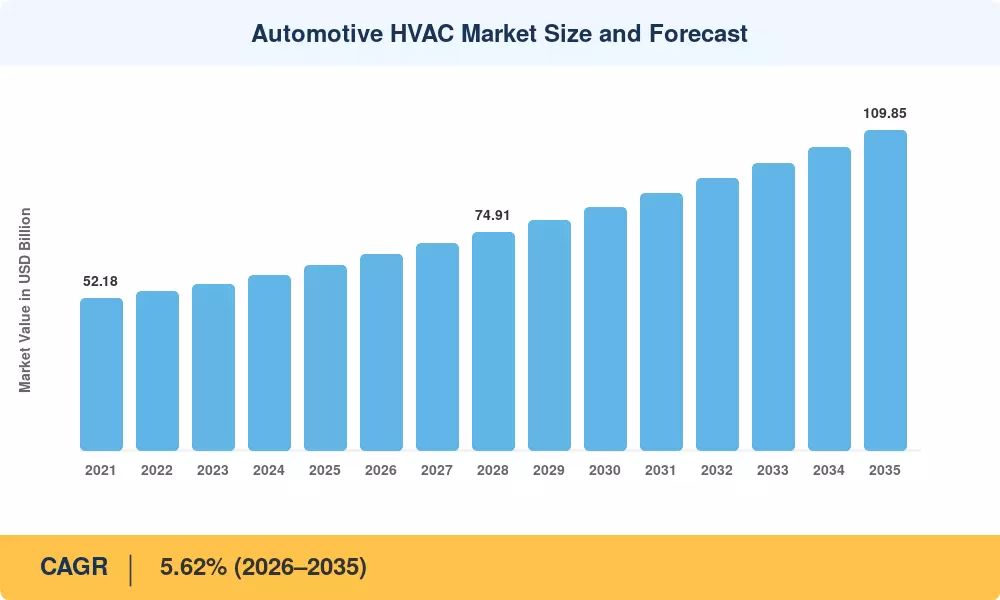
NEW YORK, NY, UNITED STATES, September 3, 2026 /EINPresswire.com/ — According to Market Research Future, the Automotive HVAC Market is projected to grow from USD 67.15 Billion in 2026 to USD 109.85 Billion by 2035, expanding at a CAGR of 5.62% across the forecast period, driven by Integration of advanced climate control technologies. This steady growth reflects the evolution of automotive HVAC from a comfort feature to a strategic energy management subsystem, where advanced climate control technologies play a critical role in defining vehicle efficiency, driving range, and occupant well-being .
Market Overview
Automotive heating, ventilation, and air conditioning systems are essential for maintaining comfortable cabin temperatures and air quality across diverse driving conditions, encompassing compressors, condensers, evaporators, electronic control units, and sensor suites. As vehicle architectures diversify from internal combustion engine platforms toward hybrids and battery electric vehicles, HVAC systems are transitioning from mechanical auxiliaries to electrically driven, software-controlled thermal management platforms that integrate with battery cooling, powertrain temperature regulation, and cabin comfort strategies .
The key growth drivers propelling this market expansion include the rapid proliferation of electric and hybrid vehicles, which require specialized, energy-efficient HVAC systems to minimize electrical load and preserve driving range . The Automotive Thermal Management System Market is closely intertwined with HVAC development, as integrated thermal strategies become essential for optimizing battery performance and cabin comfort in electric vehicles. The Automotive Air Conditioning Market continues to expand alongside broader HVAC adoption, driven by rising consumer expectations for cabin comfort and air quality across all vehicle segments.
Growing consumer demand for zonal comfort and smart climate control is driving adoption of automatic systems that can be operated remotely via mobile apps or voice commands . Regulatory mandates, including low-global-warming-potential refrigerant phase-downs and cabin air quality standards, are accelerating the adoption of advanced HVAC technologies and sustainable refrigerants . Additionally, the expanding global vehicle parc and increasing demand for premium comfort features in emerging economies continue to fuel aftermarket and OEM demand .
Technological developments are reshaping the HVAC landscape at an accelerating pace. The shift toward electric compressors, electronic expansion valves, and sensor-driven control logic is enabling precise cabin temperature management while minimizing energy consumption . The integration of IoT-based monitoring systems is making HVAC smarter, enabling real-time diagnostics and energy management capabilities . Advanced cabin air filtration and purification systems, including HEPA filters and ionization technologies, are gaining traction as consumers become more health-conscious . The adoption of heat-pump systems, which can improve EV range by up to 10-15% in cold climates compared to resistive heating, is accelerating as automakers prioritize thermal efficiency .
Market Segmentation
The automotive HVAC market is segmented based on technology type, vehicle type, component, and propulsion to provide comprehensive insights into the industry landscape.
By Technology Type: The market is categorized into Manual/Semi-Automatic HVAC and Automatic HVAC systems. Manual and semi-automatic systems held a dominant share, valued at USD 40.9 billion in 2025, driven by cost efficiency, simplified design, and lower production and maintenance expenses, making them attractive across large vehicle production volumes . However, automatic systems are expected to expand at a 9.25% CAGR through 2031, adding nearly USD 16.8 billion in incremental value, as falling sensor costs and consumer preference for connected, programmable climate control accelerate adoption . AI-based learning profiles elevate user experience, while integration with battery preconditioning benefits electric vehicles .
By Vehicle Type: The market serves Passenger Cars, Light Commercial Vehicles, Buses and Coaches. Passenger cars captured 79.62% market share in 2025 and are forecast to reach USD 107.6 billion by 2035, driven by higher global production volumes and automakers’ continued enhancement of cabin comfort features to meet consumer expectations . Buses and coaches are expected to outpace other segments at a 6.55% CAGR to 2031 as governments legislate passenger comfort mandates and ride-sharing services favor roof-mounted units with integrated HEPA filtration . Light commercial vehicles serving last-mile logistics are adopting auxiliary electric air-conditioning to allow engine-off parcel drops, reducing idling penalties in low-emission zones .
By Component: The market encompasses Compressors, Condensers, Evaporators, Electronic and Sensor Suites. The compressor segment is projected to dominate with approximately 40.12% market share in 2026, as the compressor circulates refrigerant and enables cooling and heating, with advanced variable displacement compressors offering better energy efficiency and temperature control . Sensors represent the fastest-growing component segment, expected to grow at an 8.5% CAGR between 2026 and 2035, driven by the increasing use of smart and automated climate control systems that require real-time monitoring of cabin temperature, humidity, air quality, and system performance .
By Propulsion Type: The market covers ICE Vehicles, Hybrid and Plug-In Hybrid Vehicles, and Battery Electric Vehicles. The electric and hybrid segment is expected to grow at the fastest CAGR of 7.5% through 2035 and is projected to reach USD 67.9 billion by 2035, as EVs and hybrids require highly efficient climate control systems that use power from the battery without compromising driving range . Unlike ICE vehicles, EVs depend solely on battery power for HVAC systems, making low-energy systems and advanced thermal management crucial for battery performance and safety across temperature extremes . The ICE segment, valued at USD 37.5 billion in 2025, continues to lead due to the widespread global fleet of conventional vehicles .
By Sales Channel: The market is divided into OEM Factory-Fit and Aftermarket channels. OEM remains the largest channel, with vehicle manufacturers accounting for the majority of HVAC system purchases through long-term supply agreements. The aftermarket segment is experiencing growth driven by the increasing global vehicle parc and rising demand for replacement components and upgrades .
By Region: The market analysis covers North America, Europe, South America, Asia Pacific, and the Middle East and Africa.
🛒 You can buy this market report at:
https://www.marketresearchfuture.com/checkout?currency=one_user-USD&report_id=2113
Regional Analysis
Asia Pacific dominates the automotive HVAC market, capturing approximately 48.55% of market share in 2025, driven by the region’s position as both a major production hub and one of the fastest-growing end markets for electrified vehicles . China accounted for an estimated USD 14.28 billion in 2025, the largest contributor in the region, with its NEV sales quota compelling local OEMs to adopt integrated heat-pump modules that operate efficiently in cold northern winters . Japan generated an estimated USD 4.43 billion in 2025, with Japanese suppliers exporting high-precision electronic expansion valves and reinforcing the region’s value-chain completeness . India’s blanket AC mandate for heavy trucks fuels bulk orders for rugged compressors built to tolerate high vibration, while the region’s strong supplier ecosystems in Japan, Korea, China, and India support rapid iteration of compressor technologies, heat exchanger manufacturing, and electronics integration .
North America accounted for 24.8% of the market, valued at USD 14.37 billion in 2025, reflecting a mature yet technologically progressive market . The United States generated an estimated USD 12.50 billion in 2025, supported by high vehicle ownership rates and strong consumer preference for comfort-oriented features . Pickup trucks and SUVs require high-capacity condensers to serve large cabin volumes, and frigid climates in Canada and the northern United States validate cold-weather heat-pump performance . Smart climate control technologies, including zonal management and connected controls, are gaining traction in both OEM and aftermarket channels .
Europe accounted for 22.1% of the market, reaching USD 12.80 billion in 2025, supported by the region’s enforcement of aggressive low-GWP refrigerant timelines that accelerate the adoption of R1234yf and push suppliers toward natural refrigerant prototypes . Germany led the European market with an estimated USD 3.46 billion in 2025, followed by the United Kingdom at USD 2.82 billion . Urban bus electrification programs in Germany and France stipulate energy-efficient heat-pump systems to meet tender requirements, and ISO standards set performance benchmarks that ripple through supplier quality-management systems .
South America accounted for 4.9% of the market, valued at USD 2.84 billion in 2025, with Brazil generating an estimated USD 1.22 billion . The Middle East and Africa represented 5.7% of the market, totaling USD 3.30 billion in 2025, with African markets generating USD 2.57 billion . These regions place a premium on high-capacity cooling solutions and ruggedized components designed to withstand high ambient temperatures .
Competitive Landscape and Key Players
The automotive HVAC market is competitive, featuring a mix of global tier-one suppliers, specialized thermal management providers, and regional manufacturers. The competitive landscape is characterized by technological innovation, strategic partnerships, and modular product strategies .
Key players operating in this market include Denso Corporation, Valeo SA, Hanon Systems, Marelli Holdings Co., Ltd., Mahle GmbH, Air International Thermal Systems, Sanden Holdings Corporation, Sensata Technologies, Johnson Electric, and Visteon Corporation . These industry leaders are investing heavily in electrified HVAC development including electric compressors, electronic expansion valves, and model-based control systems that reduce energy draw and enhance integration with vehicle thermal management .
Strategic developments are reshaping the competitive landscape. In November 2025, Valeo was named a CES Innovation Awards Honoree for its Compact 5-Ways Refrigerant Valve, designed to maximize the heating and cooling efficiency of heat pump systems in next-generation electric vehicles . In May 2026, DENSO Aftermarket expanded its Thermal range in Europe by launching new part numbers for its Air Conditioning and Engine Cooling portfolios, aimed at bolstering workshop inventory for the summer season . In February 2026, MAHLE Lifecycle and Mobility launched localized thermal management solutions at ACMA Automechanika New Delhi, debuting specialized AC cabin cooling kits engineered to improve driver climate comfort in commercial vehicles .
Market Challenges and Opportunities
The automotive HVAC market faces several key challenges that could impact growth trajectories. Higher unit costs for automatic and electric HVAC systems, with electronic expansion valves, stepper-motor actuators, and multi-sensor clusters elevating bill-of-materials cost by up to 50% relative to manual systems, limit penetration in entry-segment vehicles . Semiconductor shortages and procurement volatility continue to affect production schedules . The transition to low-GWP refrigerants and increased system complexity require substantial R&D investment and technician retraining . Standardization and compatibility issues across vehicle platforms force suppliers to engineer multiple variant configurations rather than benefiting from mass production efficiencies . Counterfeit products and longer EV maintenance intervals restrain aftermarket value growth .
Emerging opportunities are abundant in the evolving automotive landscape. The rapid expansion of electric vehicle production is generating long-term demand for modular and scalable thermal management platforms for battery cooling, power electronics temperature control, and cabin heating . The integration of smart sensors, IoT-based monitoring, and AI-enabled climate control solutions is creating opportunities for software-based differentiation and recurring revenue through firmware updates . The development of localized manufacturing and near-shoring capabilities helps mitigate tariff and logistics risks while preserving access to specialized capabilities . Early engagement with OEM system architects to co-develop battery cooling and HVAC synergies will influence specification decisions and secure longer-term contractual arrangements .
To explore more market insights, visit us at:
https://www.marketresearchfuture.com/reports/automotive-hvac-market-2113
Final Market Summary
The automotive HVAC market is positioned for steady growth, driven by vehicle electrification, consumer comfort expectations, and regulatory mandates for energy efficiency and environmental sustainability. The market’s trajectory from USD 67.15 Billion in 2026 to USD 109.85 Billion by 2035 reflects the evolution of HVAC from a comfort accessory to a strategic subsystem that directly impacts vehicle efficiency, driving range, and occupant well-being.
The long-term industry potential remains robust, with advancements in electric compressors, heat-pump technology, smart sensors, and AI-enabled climate control systems continuing to expand the addressable market. The convergence of HVAC with broader vehicle thermal management, including battery cooling and powertrain temperature regulation, is creating comprehensive solutions that serve diverse vehicle needs across passenger and commercial segments.
Key factors expected to influence future development include the pace of electric vehicle adoption, the evolution of refrigerant regulations, and the advancement of software-defined climate control platforms. The development of affordable, high-efficiency HVAC solutions and modular product architectures will support continued demand across both OEM and aftermarket channels. As vehicles become increasingly connected, electrified, and software-defined, the role of advanced thermal management systems will continue to evolve, ensuring sustained innovation and growth throughout the forecast period and beyond.
More Related Reports from MRFR Library:
Tire Pressure Monitoring System Market : https://www.marketresearchfuture.com/reports/tire-pressure-monitoring-system-market-4636
Automotive Rain Sensors Market : https://www.marketresearchfuture.com/reports/automotive-rain-sensors-market-4646
Automotive E Commerce Market : https://www.marketresearchfuture.com/reports/automotive-ecommerce-market-4682
Electronic Stability Control System Market : https://www.marketresearchfuture.com/reports/electronic-stability-control-system-market-4684
Hydrogen Fuel Cell Vehicle Market : https://www.marketresearchfuture.com/reports/hydrogen-fuel-cell-vehicle-market-4722
Automotive Surround View Systems Market : https://www.marketresearchfuture.com/reports/automotive-surround-view-systems-market-4733
Automotive Electric Drivetrain System Market : https://www.marketresearchfuture.com/reports/automotive-electric-drivetrain-system-market-4779
Automotive Adaptive Suspension System Market : https://www.marketresearchfuture.com/reports/automotive-adaptive-suspension-system-market-4825
Automotive Mirror Dimming Market : https://www.marketresearchfuture.com/reports/automotive-mirror-dimming-market-4826
Automotive Electronic Control Unit Market : https://www.marketresearchfuture.com/reports/automotive-electronic-control-unit-market-4835
Market Research Future
Market Research Future
+1 855-661-4441
email us here
Legal Disclaimer:
EIN Presswire provides this news content “as is” without warranty of any kind. We do not accept any responsibility or liability
for the accuracy, content, images, videos, licenses, completeness, legality, or reliability of the information contained in this
article. If you have any complaints or copyright issues related to this article, kindly contact the author above.

Media gallery