How a New Framework in Nanophotonic Technology Could Improve Biosensing
Researchers propose a framework for evaluating nanophotonic biosensors based on the information-transfer process
Press Release Disclaimer: This is a press release distributed through the XPR Media network. It has not been independently verified by our newsroom.
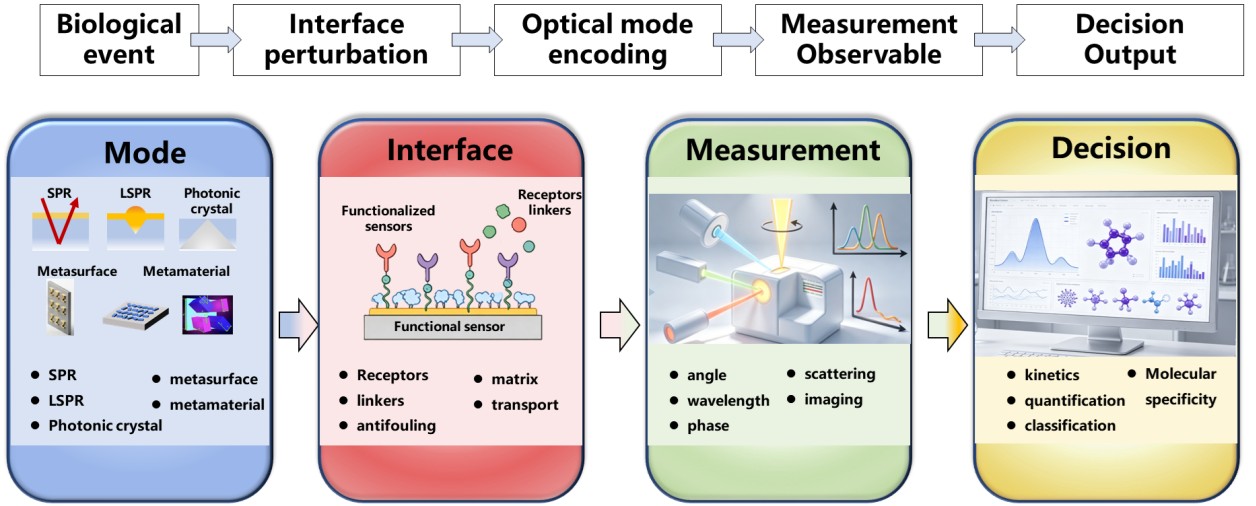

Researchers propose a framework for evaluating nanophotonic biosensors based on the information-transfer process
CHENGDU, SICHUAN, CHINA, October 13, 2026 /EINPresswire.com/ — Nanophotonic biosensors are often evaluated by device-level metrics such as sensitivity, quality factor, linewidth, and detection limit. However, these parameters alone cannot fully determine practical performance in complex biological environments. This article introduces a Mode–Interface–Measurement–Decision framework, or MIMD, to reinterpret nanophotonic biosensing as a complete information-transfer process, emphasizing how biological information is generated, preserved, measured, and finally converted into meaningful decisions.
Biosensing is the process of converting biological recognition events into measurable signals. In daily life and clinical practice, these events may involve disease biomarkers, nucleic acids, proteins, cytokines, pathogens, or small molecules. These targets are usually extremely small, present at low concentrations, and hidden in complex samples such as blood, saliva, tissue fluid, food extracts, or environmental water. Detecting them reliably is essential for early disease diagnosis, public health monitoring, food safety, environmental protection, and personalized medicine.
Optical biosensors are attractive because they can detect biological events without direct electrical contact, often without labels, and with a rapid response. Among them, nanophotonic biosensors have become especially important. They use micro- and nanoscale optical structures, such as surface plasmon resonance sensors, localized plasmonic nanoparticles, photonic crystals, metasurfaces, and metamaterials, to concentrate light into very small volumes. When a target molecule binds near the sensing surface, it can change the local refractive index, scattering response, optical phase, Raman signal, or image intensity. By reading these optical changes, a sensor can infer whether a target is present, how much of it exists, or what molecular species it may be.
Over the past two decades, this field has advanced rapidly. Surface plasmon resonance, or SPR, established a classical label-free and real-time sensing model. Localized SPR, or LSPR, reduced sensing volumes to the nanoscale and made analyte–field overlap a central design issue. Surface-enhanced Raman spectroscopy, or SERS, provided molecular fingerprint information rather than only refractive-index changes. Photonic crystal sensors, dielectric metasurfaces, and metamaterials further enabled planar, arrayed, imaging-based, and multi-parameter optical readout.
However, the practical performance of a biosensor is not determined only by how sensitive its optical resonance is under ideal laboratory conditions. A sensor with a high-quality factor, narrow linewidth, or low nominal detection limit may still perform poorly in real biological samples. Target molecules may not reach the optical hotspot efficiently. Surface chemistry may introduce nonspecific adsorption. Protective layers may reduce optical coupling. Instrumental drift and environmental noise may distort the signal. Finally, even a strong signal may not support the intended task, such as concentration estimation, kinetic analysis, molecular identification, or sample classification.
This article argues that nanophotonic biosensing should therefore be understood not simply as a device-level transduction event, but as a system-level process of information transfer. The central question is no longer only how to maximize a local optical response, but how to preserve biologically relevant information from the original molecular event to the final analytical decision.
In this work, the authors introduce a four-layer framework named Mode–Interface–Measurement–Decision, abbreviated as MIMD. This framework reframes nanophotonic biosensing as a coupled information chain. Each layer plays a distinct role, and the overall performance depends on how well the four layers are matched.
The Mode layer defines where the optical field is located and how it interacts with matter. It includes field confinement, evanescent-field depth, resonance linewidth, phase response, and mode accessibility. A strong optical mode is not automatically an effective sensing mode. If the analyte cannot enter the high-field region, or if the most sensitive field is buried inside the structure, high optical performance may not translate into useful biosensing performance.
The Interface layer determines how biological recognition is converted into a local optical perturbation. It includes receptor immobilization, linker chemistry, antifouling design, analyte accessibility, transport, molecular orientation, steric effects, and nonspecific adsorption. From this perspective, surface chemistry is not a secondary engineering step. It is a core part of the sensing system because it determines whether biological information can be faithfully transferred to the optical mode.
The Measurement layer specifies how the optical perturbation is extracted. Different systems may read out resonance-angle shifts, wavelength shifts, intensity changes, phase variations, interferometric contrast, Raman intensity, scattering spectra, or spatial image patterns. This layer strongly affects signal-to-noise ratio, dynamic range, drift tolerance, multiplexing capability, and instrument complexity. The article emphasizes that measurement architecture is not a passive observer of the optical signal, but an active determinant of information fidelity.
The Decision layer defines what the signal is ultimately used for. Possible tasks include concentration estimation, kinetic analysis, molecular identification, sample classification, and task-specific judgment. Different decision tasks require different optical modes, interfaces, and readout strategies. For example, concentration estimation depends on stable calibration, whereas molecular identification requires richer observables such as Raman spectra, absorption fingerprints, or image-based molecular barcodes.
Using the MIMD framework, the article reinterprets representative advances in SPR, LSPR, SERS, photonic crystal sensors, metasurfaces, and metamaterial biosensors. SPR is viewed as a platform that established a clear Mode–Measurement logic for real-time kinetic analysis. LSPR highlights the importance of analyte–field overlap. SERS enriches the Measurement and Decision layers by adding chemically specific molecular fingerprints. Photonic crystal sensors show how accessible optical modes and scalable readout can be balanced. Metasurfaces and metamaterials represent a transition toward explicit cross-layer co-design, where optical modes, surface interfaces, measurement observables, and final analytical tasks can be engineered together.
The article further suggests that the future of nanophotonic biosensing will move from simple linear transduction toward hierarchical information readout. Traditional linear channels, such as refractive-index-induced resonance shifts, remain valuable because they are robust, scalable, and suitable for front-end detection. However, they often provide limited molecular specificity. Future systems may combine linear detection with nonlinear, inelastic, spectroscopic, imaging-based, and data-driven channels, including SERS, second-harmonic generation, fluorescence correlation spectroscopy, and machine-learning-assisted interpretation. Such layered architectures could support robust detection, molecular identification, dynamic monitoring, and more reliable decision-making in complex samples.
The importance of this work lies in shifting the evaluation standard of nanophotonic biosensing from isolated device metrics to cross-layer information fidelity. This view helps explain why devices with excellent optical figures of merit may not always perform well in practice. It also provides a more complete design philosophy for next-generation biosensors: optical structures, biointerfaces, measurement schemes, and decision algorithms should be optimized together. This system-level approach may accelerate the translation of nanophotonic biosensors from laboratory demonstrations to practical tools for healthcare, environmental monitoring, food safety, and point-of-care diagnostics.
This work, entitled “From Device Metrics to Information Fidelity: Reframing Nanophotonic Biosensing through Mode–Interface–Measurement–Decision,” was published online in Opto-Electronic Advances on June 09, 2026.
The research team led by Professor Jiaming Lyu at Beijing Information Science and Technology University is a dynamic and forward-looking innovation team. The team currently comprises 3 Ph.D. students and 3 graduate students.
The team focuses primarily on cutting-edge research in the design and characterization of meta-surface materials, micro- and nanomaterial fabrication, and terahertz and infrared detection technologies. Its research is dedicated to addressing major national needs and tackling key technological challenges in industry.
In recent years, the team has published 9 SCI papers in high-level journals, including Opto-Electronic Advances, Light, and PhotoniX, among which one has been recognized as a Top 0.1% Highly Cited research. The team’s technological achievements have received a First Prize in the Invention category from the Ministry of Education, a First Prize from the Chinese Society for Optical Engineering, and a Silver Medal at the Geneva International Exhibition of Inventions. The team has led or participated in seven projects, including national-level projects, major provincial and ministerial projects, and technology commercialization projects, with total funding exceeding RMB 10 million, generating significant economic and social benefits.
***
Reference
Title of original paper: From Device Metrics to Information Fidelity: Reframing Nanophotonic Biosensing through Mode–Interface–Measurement–Decision
Journal: Opto-Electronic Advances
DOI: 10.29026/oea.2026.260126
Siyi Ma
Institute of Optics and Electronics, CAS
+86 19136186296
oej_publishing@ioe.ac.cn
Legal Disclaimer:
EIN Presswire provides this news content “as is” without warranty of any kind. We do not accept any responsibility or liability
for the accuracy, content, images, videos, licenses, completeness, legality, or reliability of the information contained in this
article. If you have any complaints or copyright issues related to this article, kindly contact the author above.

Media gallery