Harry Nelson and Nicholas Merkin Launch HealthcareCompliance.ai, a Platform for Governing AI in Healthcare
Companion to their book Digital Diagnosis, the site offers AI governance tools, regulatory updates, and advisory
Press Release Disclaimer: This is a press release distributed through the XPR Media network. It has not been independently verified by our newsroom.
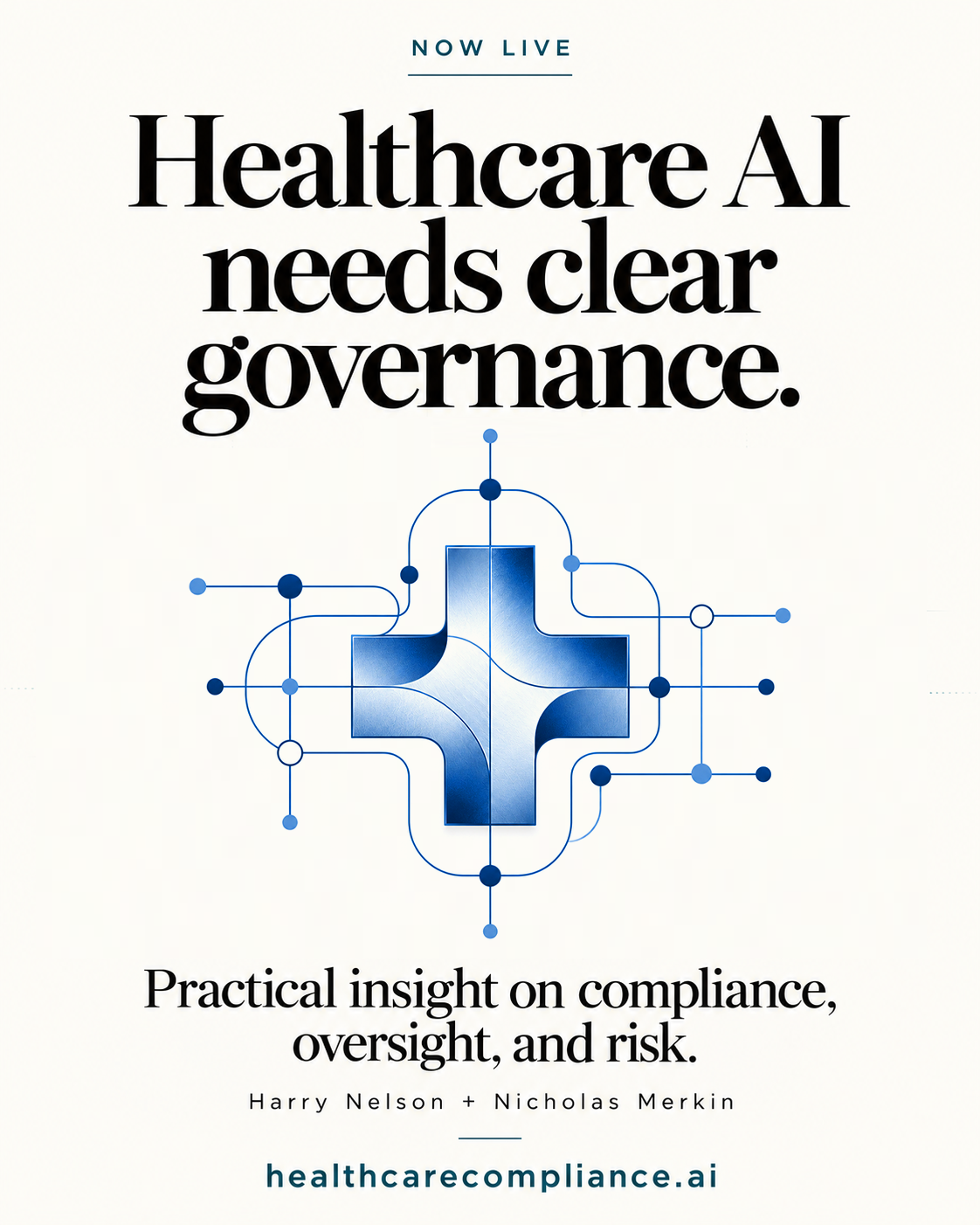

Companion to their book Digital Diagnosis, the site offers AI governance tools, regulatory updates, and advisory services built on the OIG’s Seven Elements.
LOS ANGELES, CA, UNITED STATES, October 29, 2026 /EINPresswire.com/ — Healthcare attorney Harry Nelson and healthcare compliance attorney Nicholas Merkin have launched HealthcareCompliance.ai, a platform devoted to the governance of artificial intelligence in healthcare. The site builds on their book, Digital Diagnosis: The AI Revolution in Healthcare and the Future of Regulation, and serves health systems, physician groups, behavioral health providers, legal and compliance teams, AI and digital health companies, and investors and boards.
TThe platform responds to a widening gap between AI adoption and AI oversight. By early 2026, the U.S. Food and Drug Administration had authorized more than 1,000 AI-enabled medical devices. Many more AI tools operate outside FDA review, in clinical documentation, decision support, claims adjudication, and prior authorization. Organizations often deploy these tools without written policies, structured oversight, or ongoing monitoring.
The platform’s central argument, drawn from Digital Diagnosis, is that AI does more than add a new tool to healthcare. It changes how decisions are made, how risk is assessed, and how responsibility is distributed, often without a matching change in accountability. When an algorithm shapes a diagnosis, a discharge, or a claim decision, an organization must be able to answer a basic question: who made the decision, and on what basis?
Requiring a human reviewer is necessary, but it does not settle that question. The book describes a paradox of automation bias: the more reliable an AI tool is on average, the less closely clinicians tend to check its output, and the more consequential its occasional errors become. Published research supports the concern. In a 2023 JAMA study of 457 clinicians, systematically biased model predictions reduced diagnostic accuracy, and the explanations provided with those predictions did not correct the effect.
HealthcareCompliance.ai adapts the HHS Office of Inspector General’s (OIG) Seven Elements of an Effective Compliance Program, from its November 2023 General Compliance Program Guidance, to AI-specific risk. The platform focuses on:
AI governance policies, procurement, and vendor oversight
FDA oversight of AI-enabled medical devices and clinical decision support
HIPAA, data governance, and cybersecurity for AI systems
Algorithmic bias and nondiscrimination obligations
Liability and risk allocation when AI contributes to patient harm
AI-driven reimbursement, payer algorithms, and fraud and abuse risk
Digital Diagnosis examines how existing law applies when AI shapes clinical, operational, and payment decisions. It explains why FDA clearance is not the same as local validation: more than 80 percent of AI-enabled devices reached the market through the 510(k) pathway, which compares a device to an existing product rather than testing it in a given hospital’s patient population. It shows how the FDA’s Predetermined Change Control Plan framework allows cleared tools to change after purchase, why HIPAA’s de-identification standards may not hold up against modern re-identification techniques, and how liability is shared among physicians, health systems, and vendors when an AI tool is wrong. It also revisits the 2019 Science study that found racial bias in a widely used care management algorithm.
The book’s analysis of reimbursement addresses a shift many providers are already experiencing. Providers use AI to document and code, payers use AI to score and adjudicate claims, and regulators use analytics to flag outliers. In that environment, statistical irregularity can begin to stand in for proof, and payment can slow before anyone has asked why a pattern changed. The book’s Fraud & Abuse Risk Cone helps organizations recognize when AI-driven optimization moves them from compliance improvement toward enforcement exposure. It is built around one question: when our reimbursement patterns change, can we explain why?
The book provides tools organizations can apply directly: a pre-procurement due diligence checklist, a four-part test for the clinical decision support exemption, an AI incident response protocol, a 12-month implementation roadmap, and a maturity model for self-assessment. It names HealthcareCompliance.ai as the home for its templates and ongoing regulatory updates.
Prior authorization shows why accountability needs more than a signature. Scrutiny predates AI: a 2022 HHS OIG review estimated that 13 percent of the prior authorization requests Medicare Advantage organizations denied met Medicare coverage rules. In February 2024, the Centers for Medicare & Medicaid Services (CMS) clarified that software may assist coverage decisions, but a prediction about a patient’s likely needs cannot replace an assessment of that patient’s actual condition. States have since gone further. California’s SB 1120 reserves medical necessity determinations to licensed professionals and bars software tools from denying, delaying, or modifying care on that basis. Washington permits algorithms to approve requests but requires human review before a medical necessity denial, and requires certain carriers to report annually the share of denials aided by AI. Texas SB 815 prohibits utilization review agents from using an automated decision system to make an adverse determination, in whole or in part.
Analysis on the platform argues that these laws assign decision authority but leave open how organizations demonstrate oversight in practice. A named reviewer is the starting point for accountability, not proof of it. An accountable process shows what information the reviewer considered, what role the AI output played, the basis for the decision, and how a suspected error triggers review and correction. That is the operational standard HealthcareCompliance.ai is built to help organizations meet.
The site includes dedicated pages for the book, tools and templates, advisory services, speaking, and insights. Visitors can join the waitlist for the AI Compliance Starter Kit, which includes an AI Governance Policy Template, a Pre-Deployment Risk Checklist, AI Vendor Contract Red Flags, and a Monitoring Dashboard Framework. Planned additions include OIG-aligned policy templates, risk assessment templates, self-assessment tools, and a periodic Healthcare AI Compliance Update.
Through the platform, Nelson and Merkin advise healthcare organizations, law firms, and investors on AI governance strategy, regulatory risk assessment, litigation and expert witness matters, and executive and board education.
Nelson chairs the healthcare practice at Leech Tishman and serves as an adjunct assistant clinical professor at the Keck School of Medicine of USC. He is the co-author of From Obamacare to Trumpcare and The United States of Opioids. HealthcareCompliance.ai complements HarryNelson.com, launched in July 2026 as the home for Nelson’s commentary, writing, speaking, and expert witness work. Merkin has served for more than two decades as fractional and interim Chief Compliance Officer for health systems, physician groups, behavioral health providers, digital health companies, and investors.
“Effective AI governance is not theoretical. It is operational. When something goes wrong, organizations need to be able to explain and defend what happened, and that work has to start before deployment,” Merkin said.
Harry Nelson
Harry Nelson
Visit us on social media:
LinkedIn
YouTube
Other
Legal Disclaimer:
EIN Presswire provides this news content “as is” without warranty of any kind. We do not accept any responsibility or liability
for the accuracy, content, images, videos, licenses, completeness, legality, or reliability of the information contained in this
article. If you have any complaints or copyright issues related to this article, kindly contact the author above.

Media gallery