How businesses can transition seamlessly to ISO 14001:2026 to demonstrate environmental responsibility
NQA USA reports that organizations must prepare for the upcoming ISO 14001:2026 revision, which adds new requirements
Press Release Disclaimer: This is a press release distributed through the XPR Media network. It has not been independently verified by our newsroom.

Aree_S // Shutterstock
How businesses can transition seamlessly to ISO 14001:2026 to demonstrate environmental responsibility
Organizations worldwide rely on the ISO 14001 standard to demonstrate environmental responsibility. As the world’s leading Environmental Management System (EMS) standard, ISO 14001 provides a framework for managing environmental impacts and meeting regulatory requirements. The upcoming ISO 14001:2026 revision represents a critical evolution that certified organizations must start preparing for.
The 2026 revision introduces meaningful updates that reflect ever-changing environmental policies and best practices, including expanded considerations for climate change, biodiversity and supply chain accountability. To seamlessly and effectively implement these changes, you should start planning now. Organizations that wait until publication to begin planning risk increased pressure and a higher risk of failing to adapt to the new requirements.
This guide by NQA USA breaks down the key updates, clarifies the transition timeline and provides a structured roadmap for effective preparation.
ISO 14001:2026 at a Glance
- The ISO 14001:2026 revision significantly expands environmental considerations to include climate change, biodiversity, and a strengthened life cycle perspective throughout the value chain.
- The update introduces a new formal change management requirement (Clause 6.3) for planned Environmental Management System (EMS) changes.
- Accountability is enhanced, with stronger requirements for top management involvement and expanded oversight for externally provided processes, products, and services in the supply chain.
- A three-year transition period begins in April 2026, with a deadline of May 2029, and organizations are encouraged to transition early to leverage benefits like increased auditor availability and minimized disruptions.
What Is Changing in ISO 14001:2026?
The ISO 14001:2026 revision represents a moderate evolution rather than a complete overhaul of the standard. The core structure and many fundamental requirements remain intact, but organizations seeking or retaining certification will need to pay attention to several targeted updates. These updates aim to align the standard with the current environmental landscape, including full integration of the earlier climate amendment published in 2024.
Understanding these changes now allows your organization to assess gaps in your current EMS and begin planning before the transition period creates pressure on your internal resources. Organizations that map their current practices against the new requirements early can identify which changes require minimal adjustments and which demand more significant operational or procedural modifications.
To ease future pressure on your team and resources, it’s a good idea to get to grips with the changes as soon as possible. Assessing gaps in your EMS sooner rather than later will give you more time to plan and assess the work required for each of the necessary updates. Beyond giving your team more time to make these changes, you’re also less likely to experience a shortage of external auditor availability.
NQA USA
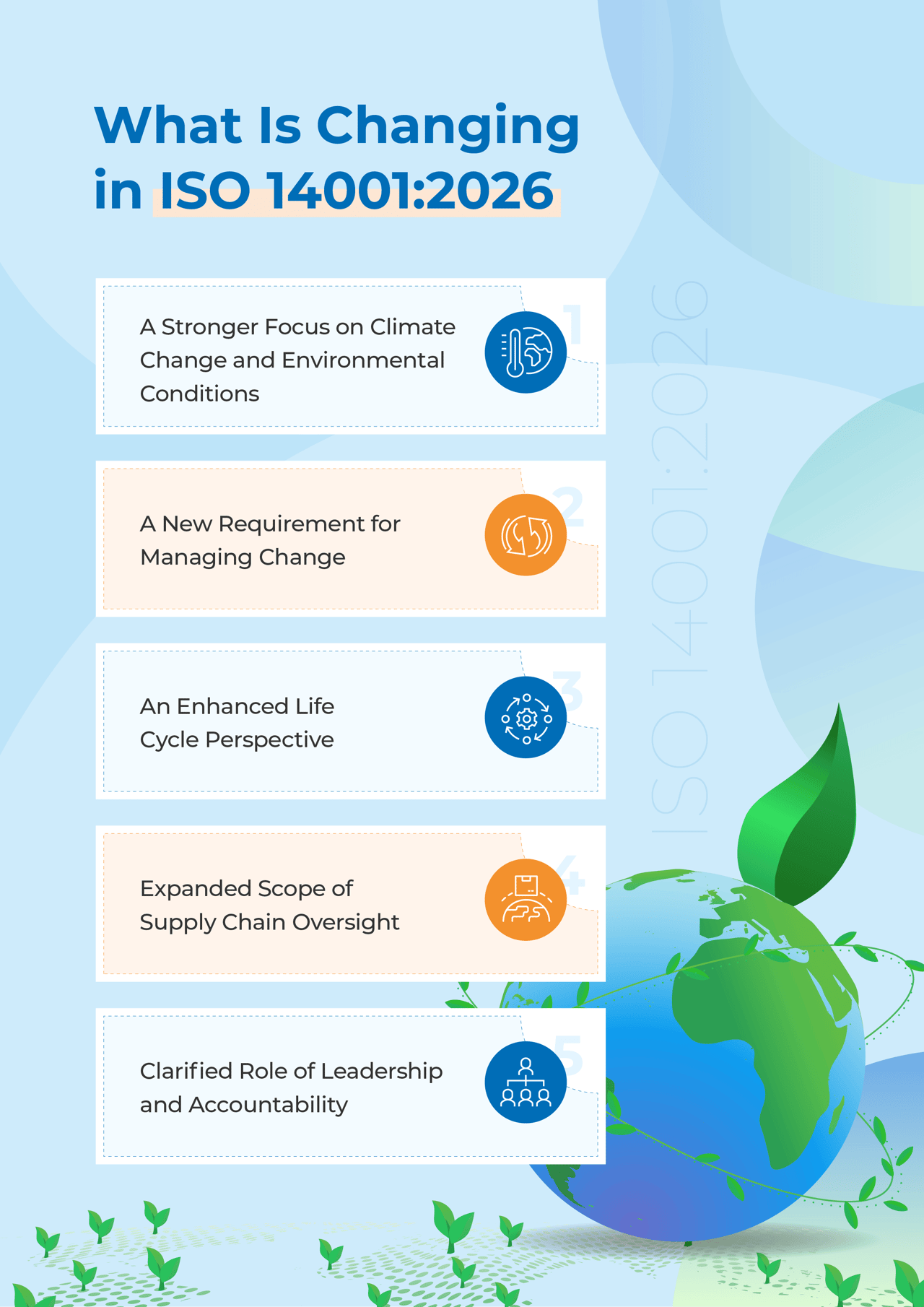
A Stronger Focus on Climate Change and Environmental Conditions
The 2024 climate amendment is now fully integrated into the ISO 14001:2026 revision, making climate change ISO 14001 requirements more explicit than in the 2015 version. These changes mean that organizations must now consider climate change as a core element of their environmental context assessment, rather than as an optional consideration.
The standard also expands the definition of “environmental conditions” to include additional factors that affect organizational context. As part of Clause 4.1 context analysis, your EMS must now account for biodiversity impacts, resource availability and local pollution issues. This broader view recognizes that environmental responsibility extends beyond carbon emissions to cover the full range of ecological impacts your organization creates or influences.
For many organizations, this change requires updating risk assessments and environmental aspect evaluations to capture additional environmental conditions. The revision emphasizes understanding how external environmental factors and your operations interact.
In practice, this might mean assessing how water scarcity affects your operations, evaluating your facility’s impact on local ecosystems or analyzing how air quality issues influence stakeholder expectations. Organizations in regions facing acute environmental pressures should document how these conditions shape their environmental strategy and operational decisions.
A New Requirement for Managing Change
ISO 14001:2026 introduces Clause 6.3, which establishes a formal change management requirement that organizations must now implement. To prevent negative environmental impacts before they occur, this clause requires a documented process for managing planned changes to the EMS.
This new clause aligns ISO 14001 with other management system standards, such as ISO 9001, which already includes change management requirements. Your organization must now demonstrate that it evaluates the environmental implications of changes before implementing them. These changes can be either internal or external, and may include:
- New equipment
- Process modifications
- Facility expansions
- Shifts in operational procedures
- New regulatory requirements
- Changes to stakeholder expectations
Your documented information should show that you considered potential environmental impacts, established controls and assigned responsibilities before making changes. Effective change management processes typically include impact assessment criteria, approval workflows, communication protocols and verification steps to confirm that environmental controls remain effective after implementation.
An Enhanced Life Cycle Perspective
While the life cycle perspective appeared in ISO 14001:2015, the 2026 revision strengthens this requirement and makes it more actionable. Organizations must now demonstrate more clearly how they consider environmental impacts throughout the entire value chain, from raw material extraction through product use and end-of-life disposal.
The focus is on an organization’s ability to “control or influence” environmental impacts at each stage of the product or service life cycle. This strengthened requirement pushes organizations to engage more rigorously in areas like procurement decisions and product design, where life cycle thinking can produce real environmental improvements.
For organizations with complex supply chains or products with significant downstream environmental impacts, this change requires more systematic documentation. This information should show how life cycle thinking influences your organization’s operational decisions.
The standard also expects organizations to identify opportunities for environmental improvement beyond their direct operational control but within their influence. For example, this might involve:
- Working with raw material suppliers to reduce extraction impacts.
- Designing products for easier recycling.
- Discussing the use of green energy with distributors to transport products more sustainably.
- Providing customers with guidance on minimizing environmental impacts during product use.
Expanded Scope of Supply Chain Oversight
The revision shifts terminology from “outsourced processes” to “externally provided processes, products and services.” This change may seem like a small wording change, but it carries practical implications for your supply chain environmental management.
The new language mirrors ISO 9001 terminology and expands accountability into the wider value chain. Organizations must now apply more rigorous oversight to suppliers and contractors who provide processes, products or services that affect environmental performance. This includes:
- Establishing environmental criteria for supplier selection.
- Monitoring supplier compliance with environmental requirements.
- Maintaining documented information about externally provided elements that affect your EMS.
The expanded scope also recognizes that environmental responsibility doesn’t stop at the organizational boundary. When your suppliers or contractors perform work that affects your environmental aspects and impacts, your EMS must address how you manage those relationships and ensure alignment with your environmental objectives.
Organizations should evaluate which suppliers have the greatest environmental influence and prioritize oversight efforts accordingly. High-impact suppliers may require environmental performance data, site assessments or contractual commitments to specific environmental standards.
Clarified Role of Leadership and Accountability
ISO 14001:2026 strengthens the accountability requirements for top management. While the 2015 version required leadership to demonstrate commitment and establish policy, the 2026 revision makes top management more explicitly accountable for the EMS’s effectiveness and performance outcomes, not just for setting direction.
This change emphasizes that environmental management is a leadership responsibility, not simply a compliance function delegated to environmental managers.
Top management must now demonstrate active involvement in reviewing performance following environmental management system changes, allocating resources and ensuring the system delivers measurable environmental improvements.
Understanding the ISO 14001:2026 Transition Timeline
Knowing the key dates for the ISO 14001 revision can help your organization plan its transition activities effectively and avoid last-minute scrambling as deadlines approach.
Key Publication Dates
The Final Draft International Standard (FDIS) for ISO 14001:2026 was released in January 2026, allowing organizations to review the final requirements before official publication.
The final version of ISO 14001:2026 was published in April 2026, at which point the official transition period begins.
However, your organization can begin preparing for the ISO 14001:2026 update before the final standard is published by using the FDIS as a reference. Early access to the requirements allows proactive organizations to start gap analysis and planning activities without waiting for the official publication date.
The Official Transition Period and Final Deadline
A three-year transition period begins upon publication of ISO 14001:2026 in April 2026. This means all ISO 14001:2015 certificates must transition to the new standard by May 2029 to remain valid. After this deadline, certificates issued to the 2015 version are no longer recognized. The three-year window applies to all certification bodies and all certified organizations worldwide.
If your organization is planning recertification audits in 2028 or early 2029, you should coordinate with your certification body to ensure the audit addresses the 2026 requirements. Waiting until the final months of the transition period could create unnecessary risk of missing the deadline.
Why an Early Transition Is a Strategic Advantage
Starting your ISO 14001:2026 certification transition early offers several practical advantages, such as:
- Increased auditor availability: As the May 2029 deadline approaches, auditors are likely to be in high demand, particularly in the final 12 months when organizations that delayed planning compete for limited audit slots. Early movers avoid this potential bottleneck and can schedule transition audits at their convenience.
- Minimized disruptions: Organizations with existing surveillance or recertification audits scheduled in 2026 or 2027 can often combine their transition activities with these planned audits. This approach can reduce the total audit time required and minimize disruption to operations, potentially saving both time and certification costs.
- Demonstrating leadership: Early transition also demonstrates environmental leadership to stakeholders. Being among the first organizations in your industry to achieve ISO 14001:2026 certification signals a commitment to environmental management best practices and staying ahead of regulatory and market expectations.
5 Steps for a Smooth Transition
Preparing your organization for ISO 14001:2026 certification requires a structured approach. While your specific implementation may vary based on your current EMS maturity and organizational complexity, you can apply general implementation steps to your transition project.
NQA USA
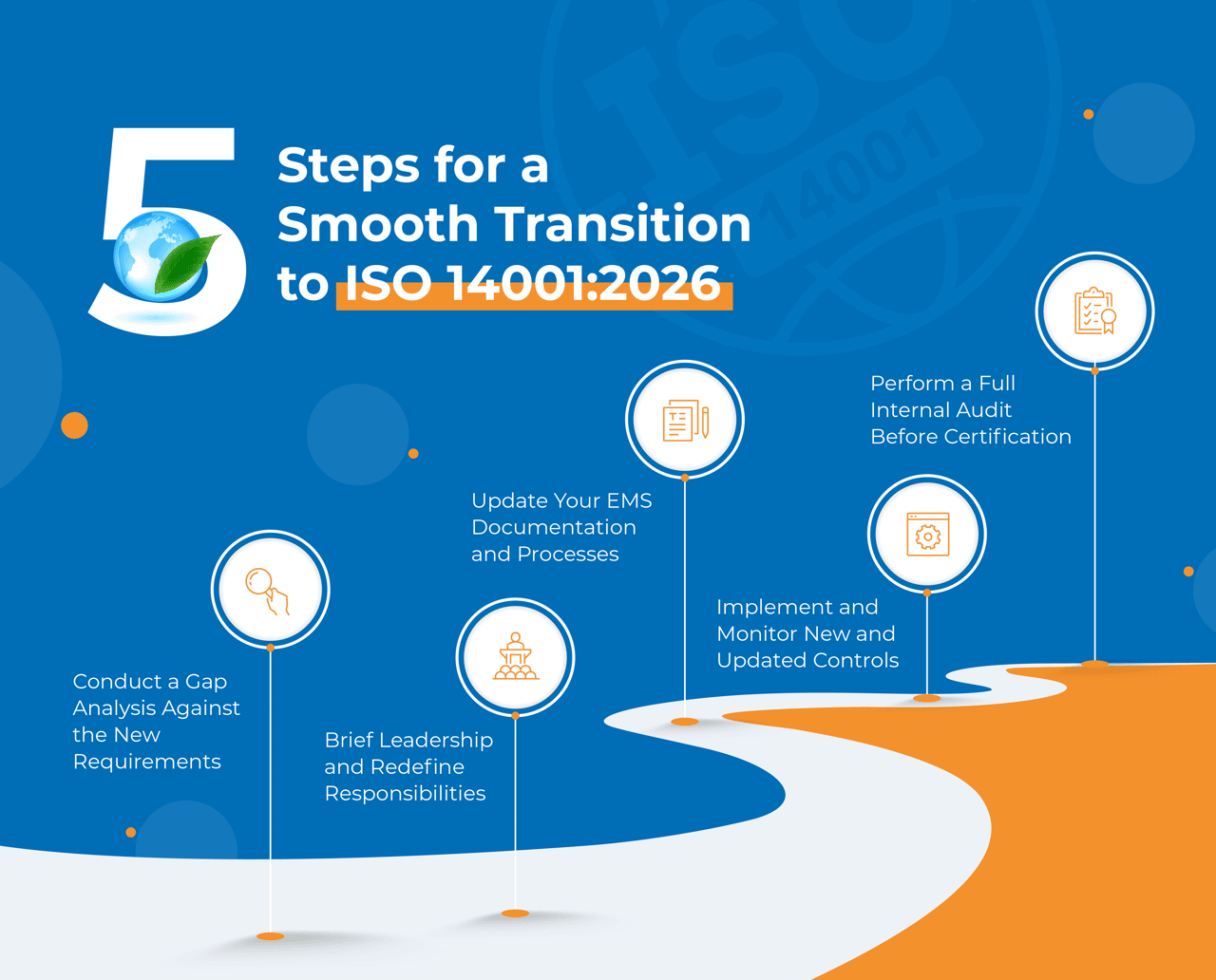
1. Conduct a Gap Analysis Against the New Requirements
Begin by comparing your current EMS against the ISO 14001:2026 standard to identify specific gaps in your processes and documented information. Focus particularly on the new and strengthened requirements:
- Climate change and expanded environmental conditions
- Change management
- Enhanced life cycle perspective
- Externally provided processes
A thorough gap analysis should examine both documented information and actual practices. Review your existing procedures, risk registers, environmental aspect evaluations and operational controls to determine what needs updating. After your review, document your findings in a format that allows you to track remediation efforts and assign responsibilities for closing each gap. Consider organizing findings by clause number to simplify tracking and ensure comprehensive coverage of all requirements.
2. Brief Leadership and Redefine Responsibilities
Present your gap analysis findings to top management and secure their commitment to the transition project. Thanks to the new framework’s increased emphasis on management accountability, leadership buy-in is essential, particularly if resource allocation is needed to update systems, train personnel or engage suppliers on environmental criteria.
Formally assign responsibility for overseeing the transition project and establish clear timelines for completing each phase. Depending on your organization’s size and complexity, you may need to establish a transition team with representatives from operations, procurement, quality and environmental functions to address the cross-functional nature of the new requirements.
Define who has decision-making authority for the transition project to avoid delays when questions or obstacles arise during implementation.
3. Update Your EMS Documentation and Processes
Update your documented information to reflect the new requirements. This includes:
- Revising your environmental policy.
- Updating procedures to include the new change management ISO 14001 processes.
- Expanding your context analysis to address climate change and other environmental conditions.
- Documenting how you address externally provided processes and life cycle perspectives.
Auditors will verify that your documented procedures match operational reality, so this is an opportunity to close any gaps between written procedures and actual work processes. Consider piloting new procedures in one department or location before rolling them out organization-wide to identify practical implementation issues early.
4. Implement and Monitor New and Updated Controls
After updating documented information, put the new operational controls into practice by implementing your change management process, applying enhanced supplier oversight procedures and integrating expanded environmental considerations into decision-making processes. Train relevant personnel on the updated requirements and their responsibilities under the revised EMS.
After implementing your operational controls, it’s important to monitor their effectiveness. Track whether:
- Change management processes catch planned changes before implementation.
- Supplier oversight successfully identifies environmental risks.
- Expanded context considerations influence decisions as intended.
Address any implementation issues before your internal audit and collect evidence that demonstrates controls are functioning properly. This evidence could be completed change management forms, supplier assessment records or updated risk assessments that reflect expanded environmental conditions.
5. Perform a Full Internal Audit Before Certification
Conduct a comprehensive internal audit specifically focused on the new and updated requirements before scheduling your certification audit. The internal audit should have defined objectives that include:
- Testing Clause 6.3 change management.
- Verifying expanded context analysis under Clause 4.1.
- Confirming life cycle thinking in procurement and design decisions.
- Validating supplier oversight procedures.
This final check allows you to identify and correct any remaining gaps before the external auditor arrives. Internal auditors should look for evidence of effective implementation, not just the existence of documented information. Prepare for your official audit by ensuring audit trails are complete, responsibilities are clear, and personnel can explain how the new requirements affect their work.
Common Pitfalls to Avoid During the Transition
Learning from common mistakes helps organizations navigate the ISO 14001 revision more smoothly. The following pitfalls represent issues that frequently create problems during transition projects.
Waiting Too Long to Start the Process
Delaying transition planning until 2028 or early 2029 creates unnecessary pressure. Auditor availability can become constrained as the deadline approaches, and your organization may struggle to secure audit slots at preferred times. Internal resources also face time pressure, increasing the likelihood of rushed implementation that doesn’t effectively embed new requirements into the organizational culture.
Starting now allows you to spread the work across multiple budget cycles, integrate updates with normal business planning processes and avoid competing with other urgent projects for resources as the deadline looms. Organizations that begin early can also take advantage of learning opportunities as certification bodies develop expertise with the new requirements and share best practices from early adopters.
Underestimating the Impact on Your Supply Chain
The shift to “externally provided processes, products and services” requires more than updating a procedure document. Organizations must engage with suppliers early to communicate environmental expectations, establish monitoring mechanisms and potentially reevaluate supplier relationships if environmental performance doesn’t meet requirements.
However, changes to supply chain environmental management take time to implement effectively. Your suppliers may need to provide additional documented information, modify their own processes or demonstrate compliance with environmental criteria they haven’t previously tracked. Building these capabilities requires lead time that last-minute transitions don’t provide.
Some organizations discover during transition that key suppliers lack the systems to provide the required environmental data, necessitating supplier development efforts or alternative sourcing strategies that can take months to implement.
Treating the Update as a Simple Paperwork Exercise
The most common failure mode in ISO transitions is treating the revision as a documentation update rather than an operational improvement opportunity. Auditors look for evidence that new requirements are embedded in daily operations, not just described in procedures that personnel don’t follow.
Effective implementation means training staff on what’s changing and why, integrating new requirements into existing workflows and decision-making processes, and demonstrating that controls actually function as documented. Organizations that invest in genuine implementation rather than superficial documentation updates typically transition smoothly and gain more value from their EMS.
The revision offers an opportunity to strengthen environmental performance rather than simply maintain certification status. Organizations that approach the transition with this mindset often identify improvement opportunities beyond what the standard strictly requires.
Preparing for ISO 14001:2026 Starts Now
The ISO 14001:2026 revision introduces significant updates, but a structured approach can make the transition manageable. The three-year window provides plenty of time for thoughtful implementation if you start planning now rather than waiting until auditor availability tightens.
Success depends on early gap analysis, leadership engagement, thorough documentation updates and rigorous internal auditing before certification. Organizations that embed the new requirements into daily operations typically transition without disruption, while those treating it as a paperwork exercise often struggle. As you plan your transition, choosing the right certification body can make a significant difference.
This story was produced by NQA USA and reviewed and distributed by Stacker.