
Rare Earths Americas Tests Mineralization Expansion Potential at the Alpha Heavy Rare Earths Project
The Alpha Project currently hosts an inferred 202 Mt at 1,520 ppm total rare earth oxide ("TREO") Ionic Adsorption
Press Release Disclaimer: This is a press release distributed through the XPR Media network. It has not been independently verified by our newsroom.


The Alpha Project currently hosts an inferred 202 Mt at 1,520 ppm total rare earth oxide (“TREO”) Ionic Adsorption Clay (“IAC”) resource within a district-scale land position that REA has previously identified as having the potential to become a large-scale IAC resource. Updated geological modeling indicates that the current resource was constrained by the depth limitations of historical auger drilling, rather than the limits of the mineralized system. The modeling also indicates an increasing proportion of heavy rare earths with depth, including dysprosium (“Dy”) and terbium (“Tb”). In parallel, REA continues to methodically advance and de-risk Alpha through resource conversion, technical studies and permitting initiatives.
This press release features multimedia. View the full release here: https://www.businesswire.com/news/home/20260909494551/en/
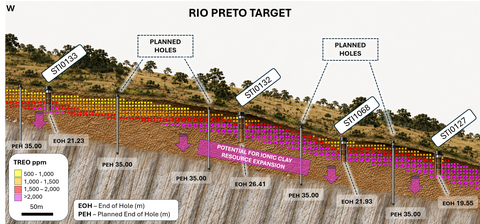
Figure 1 – Schematic section of Alpha mineralization to demonstrate the open nature of the rare earths mineralization. The Rio Preto Target is a subsection of the Alpha resource, see Figure 7 for cross section location. Note: Actual TREO data shown, background image is illustrative. This Figure 1 represents re-interpretations of previously reported drilling data and does not constitute new exploration results.
Highlights:
- Large-Scale IAC Resource with Strong Magnet Rare Earth Content: Alpha’s existing resource contains meaningful concentrations of the four key magnet rare earths, including 322 ppm neodymium and praseodymium (“NdPr”) and 39 ppm DyTb, providing context for the resource conversion and exploration activities now underway.
- IAC Advantages: These deposits can offer significant processing advantages over hard-rock rare earth projects. At Alpha, the rare earths are adsorbed onto clay particles and can be recovered, using comparatively simple leaching techniques that reduce reagent and energy requirements, processing complexity and potentially both capital and operating costs.
- Updated Modeling Suggests Mineralization May Extend Beyond Historical Drilling Depths: Updated geological modeling indicates that portions of Alpha’s current resource were constrained by the practical depth limits of historical auger drilling, which averaged 16.5 meters, rather than the true thickness of the mineralized horizon, which remains open at depth.
- Heavy Rare Earth Enrichment Increases with Depth: Geological modeling at the Sapucaia and Rio Preto targets (Figures 2 and 7) indicates an increasing proportion of heavy rare earths with depth, including the high-value magnet rare earths dysprosium and terbium, highlighting the potential for a higher-value rare earth basket at depth.
- Yttrium (Y₂O₃) grades exceeding 300 ppm and Gadolinium (Gd₂O₃) grades exceeding 40 ppm persist to the end of multiple drill holes: The continuation of elevated yttrium and gadolinium grades to the bottom of multiple holes, combined with mineralization remaining open at depth and showing no evidence of grade depletion, suggests potential for additional mineralization at depth, the economic significance of which has not yet been established and will be evaluated as part of the ongoing Initial Assessment (see Figures 3, 4 and 6 – 10).
- 13,400-Meter Reverse Circulation (“RC”) Program Testing Mineralization Expansion Potential and Increasing Heavy Rare Earth Distribution at Depth: REA’s ongoing drilling program, which has commenced is testing modeled extensions below the current resource, advancing resource conversion to Indicated and Measured categories, and evaluating whether deeper mineralization can both expand Alpha’s resource base and increase the contribution of high-value heavy rare earths.
- Advancing Alpha Toward Development: Environmental baseline studies have commenced in support of the project’s permitting pathway while REA continues work on its previously announced Initial Assessment.
Rare Earths Americas’ CEO, Donald Swartz, commented: “Alpha already hosts a significant rare earth inferred resource, and the work underway is focused on understanding whether the resource may extend beyond the limits of historical drilling and whether the heavy rare earth content increases at depth. Historical auger drilling was effective in defining the existing resource, but in many areas, it reached its practical depth limit while mineralization was still present.
Our updated geological modeling is helping us better understand what may exist below those historical drilling limits, including indications that the proportion of high-value heavy rare earths such as dysprosium and terbium increases with depth. We are now testing those opportunities with deeper drilling while, in parallel, continuing to advance Alpha through resource conversion, technical studies and permitting. Taken together, this work is about both testing whether the resource extends at depth and systematically advancing the project.”
Rare Earths Americas, Inc. (“REA” or the “Company”) is advancing multiple exploration and development initiatives at its Alpha Rare Earths Project, including efforts to expand the project’s mineral resource potential and increase exposure to high-value heavy rare earth elements. Historical drilling has already demonstrated the district-scale nature of Alpha (Figure 7), while the Company’s current drilling program is designed to drive resource conversion and test the potential for increased mineralization and a higher-value rare earth mix at depth. In parallel, REA has commenced the environmental baseline studies required for future permitting, marking an important step in systematically de-risking the project and advancing Alpha toward potential development.
Growing Heavy Rare Earths Potential: While advancing the previously announced Initial Assessment (see here), REA has identified opportunities to further enhance the Alpha Project through potential increases in resource grade, tonnage, and the relative contribution of high-value heavy rare earth oxides (“HREOs”) in the total rare earths basket, which may have positive implications for the project’s economic evaluation.
Historical resource delineation at Alpha was primarily completed using auger drilling, an effective and cost-efficient method that was generally limited by hole depth, which the average depth is 16.5 meters, while still intersecting mineralization (see Figure 3 & 4). As part of the Company’s ongoing infill drilling program, REA is utilizing RC drilling to test mineralization beyond the depths reached by previous auger holes and test the full extent of the ionic clay layer. The Company believes this work could support an expansion of the existing resource at depth (see Figure 1).
In addition to the mineralized system remaining open at depth, current drilling indicates that HREO enrichment also remains open below the deepest drill intersections at both the Sapucaia and Rio Preto targets, including Dy and Tb. As illustrated in Figure 2, the proportion of HREOs within the TREO basket exhibits an increasing trend with depth. Should this trend continue, future drilling may not only expand the mineralized footprint at depth but potentially increase the proportion of high-value HREOs within the project’s rare earth basket (See Figure 2, 3 & 4).
Given the higher market value of Dy and Tb relative to other key magnetic rare earths, such as NdPr, the presence and proportion of HREOs at depth will be an important factor in the ongoing Initial Assessment’s evaluation of project economics. However, the extent, continuity, grade distribution, metallurgical characteristics, and economic significance of any deeper mineralization have not yet been established and remain subject to additional drilling, resource estimation, technical studies, and economic evaluation.
Development Update: REA has commenced the environmental baseline studies required for the preparation of an Environmental Impact Assessment (“EIA”) and corresponding Environmental Impact Report (“RIMA”), representing an important milestone in the project’s environmental regularization process in Brazil. The Preliminary License (“LP”) is the first and most comprehensive stage of permitting and requires approximately 12 months of environmental monitoring and data collection to establish baseline site conditions prior to development. The Company is targeting submission of its LP application by year-end 2027.
The Brazilian mine permitting process consists of three main stages:
- Preliminary License (“LP”) (underway; targeted application submission by year-end 2027): The initial stage of the licensing process, requiring completion of an EIA and corresponding RIMA. This phase includes approximately 12 months of environmental baseline studies to characterize existing environmental conditions before project implementation and establish the foundation for future development approvals.
- Installation License (“LI”): Authorizes the construction and installation of the mine and associated infrastructure in accordance with approved environmental plans, engineering designs, and regulatory conditions.
- Operation License (“LO”): Authorizes the commencement of commercial mining operations following completion of construction and confirmation that all applicable environmental and regulatory requirements have been satisfied.
The commencement of baseline studies represents an important milestone in advancing Alpha along the development pathway and reflects the Company’s commitment to systematically de-risking the project while advancing toward potential future development.
About Rare Earths Americas
Rare Earths Americas, Inc. is an exploration stage company advancing a portfolio of critical minerals projects focused on high-grade rare earth mineral assets in the United States and Brazil. REA’s portfolio includes three material projects, which the Company believes positions REA as a future potential cornerstone of non-Chinese rare earth supply, aligning with Western industrial and national security priorities. Rare earths elements are essential for advanced U.S. industries including robotics, electric vehicles, energy, defense, and consumer electronics.
What are Rare Earths?
Rare earth elements are a group of 17 specialty metals critical to a wide range of advanced and everyday technologies. They are used in high-performance permanent magnets, particularly neodymium-iron-boron (NdFeB) magnets, which enable high strength and efficiency in applications such as robotics, electric vehicles, defense systems, wind turbines, and consumer electronics. In simple terms, motion generated by electricity is often powered by NdFeB magnets, making rare earths essential inputs in everyday items, from the motor that raises and lowers a car window to the motors used in drones and humanoid robots.
Of the 17 rare earth elements, neodymium (Nd), praseodymium (Pr), dysprosium (Dy), and terbium (Tb) are the key materials used in high-performance permanent magnets. Dy and Tb are particularly valuable due to their ability to enhance magnet performance at high temperatures.
According to Adamas Intelligence, China accounts for over 90% of global Dy and Tb production. This concentration has increased the strategic importance of developing new rare earth projects in other jurisdictions to support supply chain diversification and long-term demand growth.
Forward-Looking Statements & Technical Notes
This communication contains forward-looking statements within the meaning of Section 27A of the Securities Act of 1933, as amended, and Section 21E of the Securities Exchange Act of 1934, as amended. When used in this communication, the words “plan,” “target,” “anticipate,” “believe,” “could,” “designed to,” “estimate,” “expect,” “focused on,” “intend,” “may,” “opportunities,” “potential,” “seeks,” “should,” “will,” “would” and similar expressions are intended to identify such forward-looking statements. Any express or implied statements contained in this communication that are not statements of historical fact may be deemed to be forward-looking statements.
Forward-looking statements in this communication include, but are not limited to: the potential for the Alpha Project to become a large-scale IAC resource; the potential to expand the existing IAC mineral resource at the Alpha Project, including potential increases in resource grade, tonnage, or the relative contribution of HREOs; the expectation that deeper RC drilling may intersect continued mineralization or higher proportions of heavy rare earth elements (including dysprosium and terbium) at depth; beliefs regarding the potential for a higher-value rare earth basket or enhanced rare earth product mix resulting from HREO enrichment at depth; the potential for deeper mineralization to positively influence the project’s overall economics or strategic importance; statements regarding the anticipated processing advantages of IAC deposits, including expectations regarding reagent and energy requirements, processing complexity, and capital and operating costs relative to hard-rock rare earth projects; our plans and objectives for the ongoing 13,400-meter RC drilling program, including the objective of advancing resource conversion from Inferred to Indicated and Measured categories; the successful advancement of the previously announced Initial Assessment; our ability to advance the Alpha Project toward potential development or future production; the targeted timelines for the Brazilian environmental licensing process (including the EIA/RIMA and Preliminary License application by year-end 2027) and the anticipated duration of each permitting stage; the belief that the commencement of environmental baseline studies represents a milestone in advancing the project along the development pathway; statements regarding the Company’s position as a future potential cornerstone of non-Chinese rare earth supply; and assumptions underlying the updated geological modeling, including assumptions regarding the extension of mineralization and HREO enrichment trends beyond the depth limits of historical auger drilling.
There is no certainty that continued exploration will result in the definition of an expanded, higher-grade, or higher-value mineral resource, that historical geological modeling or depth trend analysis will accurately predict mineralization or HREO enrichment at depth, that the ongoing RC drilling program will successfully convert Inferred resources to Indicated or Measured categories, that metallurgical testing will confirm anticipated processing advantages, that the Initial Assessment will demonstrate favorable project economics, or that the Company will secure necessary environmental and operating permits on its anticipated timeline, or at all. The extent, continuity, grade distribution, metallurgical characteristics, and economic significance of any deeper mineralization have not yet been established and remain subject to additional drilling, resource estimation, technical studies, and economic evaluation.
These forward-looking statements are based on assumptions and expectations that may not be realized and are inherently subject to numerous risks and uncertainties, which could cause actual results to differ materially from these statements. These risks and uncertainties include, among others: the execution, cost, and timing of our planned exploration and RC drilling activities; the inherent uncertainties of geological modeling, depth extrapolation, and historical auger drilling data; uncertainties as to whether observed trends in HREO enrichment with depth will continue or prove economically meaningful; the risk that deeper mineralization, if present, may not be continuous, of sufficient grade, or economically extractable; the preliminary nature of the updated geological modeling, which is based on re-interpretations of previously reported data and has not yet been confirmed by the ongoing drilling program; the risk that the Initial Assessment may not demonstrate favorable project economics; the significant capital requirements to complete planned drilling, technical studies, and permitting activities; regulatory and permitting risks specific to mining operations in Brazil, including the risk that the environmental licensing process may take longer or cost more than anticipated; our ability to achieve our strategic goals and advance technical studies; political, economic, and trade policy risks in Brazil and the United States, including tariff and export-related risks; fluctuations in rare earth element prices, including the prices of dysprosium, terbium, neodymium, and praseodymium; currency exchange rate fluctuations between the U.S. Dollar and the Brazilian Real; our need for substantial additional capital and the availability of financing on acceptable terms; the state of the economy and financial markets generally; and the market for our common stock. The foregoing list is not exhaustive.
For additional information regarding factors that may cause actual results to differ materially from those indicated in our forward-looking statements, we refer you to the risk factors included in the Company’s Rule 424(b)(4) Prospectus filed on May 7, 2026 and the Company’s Quarterly Report on Form 10-Q for the quarter ended March 31, 2026, which are available at www.sec.gov. We caution investors not to place undue reliance on the forward-looking statements contained in this communication. These statements speak only as of the date of this communication, and we undertake no obligation to update or revise these statements, whether as a result of new information, future events or otherwise, except as may be required by law. We do not give any assurance that we will achieve our expectations.
Data Verification and QA/QC
The historical exploration data, drill hole results, assays, and geological interpretations referenced herein have been previously disclosed and verified under industry-standard QA/QC procedures. No new material technical information, exploration results, mineral resources, mineral reserves, or geochemical data are reported in this release. Additional details regarding data verification, QA/QC protocols, assumptions, and limitations for the Alpha Project are available in the Company’s final Prospectus. Exploration results should not be construed as mineral resources or mineral reserves, nor as evidence of economic viability.
Qualified Person Information
Leandro Coracini Ollita, Qualified Person registered with the Brazilian Commission for Resources and Reserves (CBRR), Registration No. 023160, who is a “qualified person” within the meanings of S-K 1300, has reviewed and approved the disclosure of technical information contained in this press release, including the evaluation of the lithochemical model and the development of the conceptual assumptions described in this document, which have not yet been confirmed, and may or may not be confirmed upon the completion of the ongoing resource conversion drilling program. Furthermore, Mr. Ollita has monitored the commencement of the preliminary environmental studies aimed at establishing the baseline data required for the future formalization of the environmental licensing process in Brazil. Mr. Ollita is an employee of a wholly-owned Brazilian subsidiary of the Company.
View source version on businesswire.com: https://www.businesswire.com/news/home/20260909494551/en/
Media gallery

