How the $40,000 SALT expansion creates high-tax winners and income traps
Ownwell reports that the $40,000 SALT deduction cap, effective in 2025, benefits high-tax homeowners while high earners
Press Release Disclaimer: This is a press release distributed through the XPR Media network. It has not been independently verified by our newsroom.


Cast Of Thousands // Shutterstock
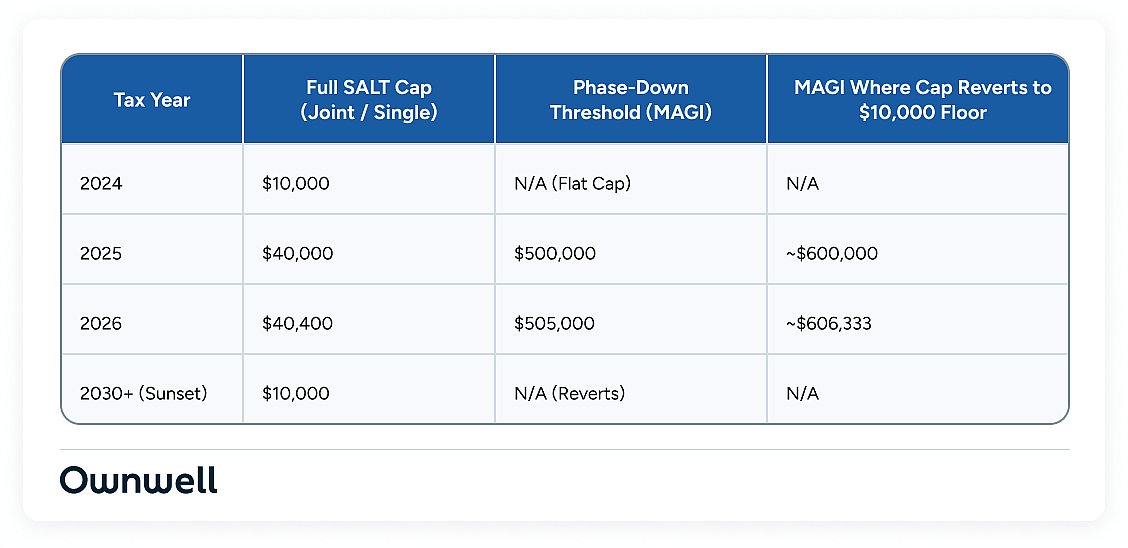
When federal lawmakers enacted the One Big Beautiful Bill Act (OBBBA)—officially titled H.R.1 in the 119th Congress—they reshaped American homeownership tax policy. By raising the State and Local Tax (SALT) deduction cap from its longstanding $10,000 ceiling to $40,000 in 2025, and increasing it to $40,400 for tax year 2026, Congress delivered a massive, albeit temporary, tax policy shift.
However, as Ownwell explains below, a closer look at the Internal Revenue Code shows this $40,000 expansion is far from a universal windfall.
Beneath the headline cap lies a complex web of regional disparities, aggressive phase-down mechanisms for high earners, and structural advantages that favor real estate investors over primary homeowners.
The Geographical Windfall: High-Tax Municipalities vs. Modest Tax Regions
The impact of the expanded SALT cap depends heavily on geographic location. Prior to the passage of H.R.1, millions of homeowners in high-cost, high property tax states, such as New Jersey, New York, California, and Illinois, were writing off only a fraction of their actual tax payments due to the strict $10,000 limit established by the 2017 Tax Cuts and Jobs Act (TCJA).
According to data from the U.S. Census Bureau and the Tax Foundation, median annual property tax bills in counties like Essex County, NJ ($13,000-plus), Westchester County, NY ($14,000-plus), and Lake County, IL ($10,000-plus) routinely eclipsed the former cap on real estate taxes alone, before even accounting for state income taxes.
High-Tax Metro Areas: For a married couple in Bergen County, NJ, paying $18,000 in local property taxes and $15,000 in state income taxes ($33,000 combined SALT), the original TCJA cap left $23,000 of paid taxes completely undeductible on Schedule A (Form 1040).
Under the updated $40,400 cap for 2026, the entire $33,000 bill can now be deducted, delivering thousands of dollars in net federal tax relief.
Modest Property Tax Regions: Conversely, in states like Alabama, West Virginia, or Arkansas, where median annual property tax bills range from $700 to $1,200, the quadrupled cap changes very little.
For most homeowners in these regions, the standard deduction ($16,100 for single filers and $32,200 for joint filers in 2026) remains far more advantageous than itemizing on Schedule A.
The $500,000 Income Trap: How the MAGI Phase-Down Operates
While upper-middle-class households in high-tax suburbs represent the primary beneficiaries of the $40,000 cap, high-net-worth individuals face a policy barrier: the Modified Adjusted Gross Income (MAGI) phase-down.
Under IRS guidelines established by OBBBA, the expanded SALT cap begins to roll back once a household’s MAGI surpasses $500,000 ($505,000 for tax year 2026 and half these amounts for married filing separately).
How the Phase-Down Math Works
- Reduction Rate: For every $1.00 of MAGI above the $505,000 threshold (in 2026), the allowable SALT deduction shrinks by $0.30.
- The Floor: The deduction cannot fall below a $10,000 floor ($5,000 for married filing separately).
- The High-Earner Limit: By the time a joint-filing household reaches approximately $606,333 in MAGI in 2026, their allowable SALT deduction drops back down to the old $10,000 limit.
Ownwell
This phase-down raises the effective marginal tax rate for high earners in high-tax jurisdictions, gradually reducing the available deduction for households with incomes between $500,000 and $606,333 across the 2025-2026 tax years.
Primary Residences vs. Real Estate Investors: The Schedule E Advantage
A critical distinction in federal tax law lies between personal real estate and investment property. While primary residences and non-rental vacation homes are constrained by Schedule A limits and the SALT cap, rental and commercial properties operate under entirely different rules.
According to Internal Revenue Code guidelines, property taxes paid on rental properties rented for more than 14 days per year are classified as ordinary business expenses on Schedule E (Form 1040).
100% Deductibility: Property taxes deducted on Schedule E are not subject to the $40,000 SALT cap, nor are they subject to the $500,000 MAGI phase-down.
Pass-Through Entity (PTE) Workarounds: Additionally, business owners and real estate investors utilizing S-corporations or partnerships can leverage state-level Pass-Through Entity Tax elections.
Over 35 states have enacted PTE legislation that lets business owners pay state income taxes at the entity level, bypassing personal SALT caps on business income and freeing up individual deduction space for personal property taxes.
The 2030 Expiration Clock and the Role of Assessment Appeals
A crucial detail property owners often miss is that the $40,000 SALT cap is temporary. Under H.R.1 provisions, the cap increases by 1% annually through 2029, then automatically reverts to $10,000 in tax year 2030 unless Congress extends it.
Because tax write-offs only mitigate a fraction of out-of-pocket costs based on a filer’s marginal bracket, housing policy experts emphasize that relying solely on federal tax deductions is an incomplete financial strategy.
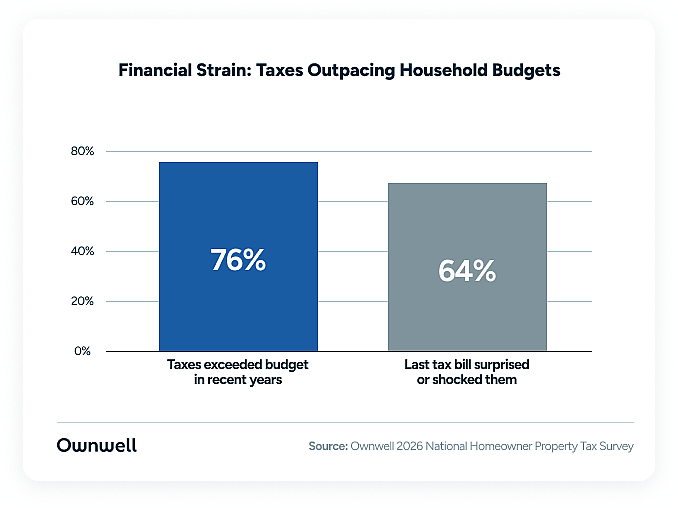
Recent industry analysis from Ownwell indicates that roughly 64% of homeowners experience “sticker shock” when they receive their local property assessment notices.
Ownwell
Reducing a property’s assessed value at the county level offers direct, permanent tax reduction before federal deduction caps ever enter the equation.
Strategic Considerations for the 2025-2026 Tax Years
For homeowners evaluating their tax strategy over the current 2025-2026 filing windows, financial advisors recommend three key steps:
1. Run the Itemization Threshold: Compare total itemizable expenses (mortgage interest under the $750,000 debt limit, charitable contributions, and eligible SALT up to $40,400) against the standard deduction ($16,100 single / $32,200 married filing jointly).
2. Review Assessment Accuracy: Conduct a thorough audit of your local county assessment records to identify potential inaccuracies or inflated valuations. Because property taxes are calculated based on these assessments, successfully challenging an inaccurate valuation provides guaranteed savings that exist independently of federal tax deduction caps.
3. Mind the Escrow Payment Timing: Property tax deductions are recognized in the tax year your mortgage servicing company remits payment to the local tax authority, not when your monthly escrow payments are deposited into your lender’s account.
This story was produced by Ownwell and reviewed and distributed by Stacker.